“The manual is in English.” That sentence is heard constantly in maintenance departments. It describes a situation nobody planned. The equipment comes from Italy or Japan, the manufacturer’s documentation is in English, and the people working with it each morning ask questions in German.
The “obvious” solution is translation. At NXTGN, we rejected it.
Two approaches with the same flaw
There were two options. Either translate the question and search twice, once in German and once in English. Or translate the documents during ingestion and store both versions.
The first approach costs an additional language-model call for every search. The second requires twice the storage and a significantly longer onboarding process.
But those are only costs, and costs can be discussed. The more serious objection is different: in both cases, the translation becomes part of the knowledge collection.
A mistranslated technical term then appears in the answer to the next question. In the knowledge article someone writes from it. In the work instruction that follows. And eventually in the mind of a technician who believes it is the correct term.
Nobody can tell that it once meant something else.
The third approach
An AI solution consists of several programs with separate tasks, not one program. The best-known is the language model. It formulates the final answer, and it is what most people mean when they say “the AI”.
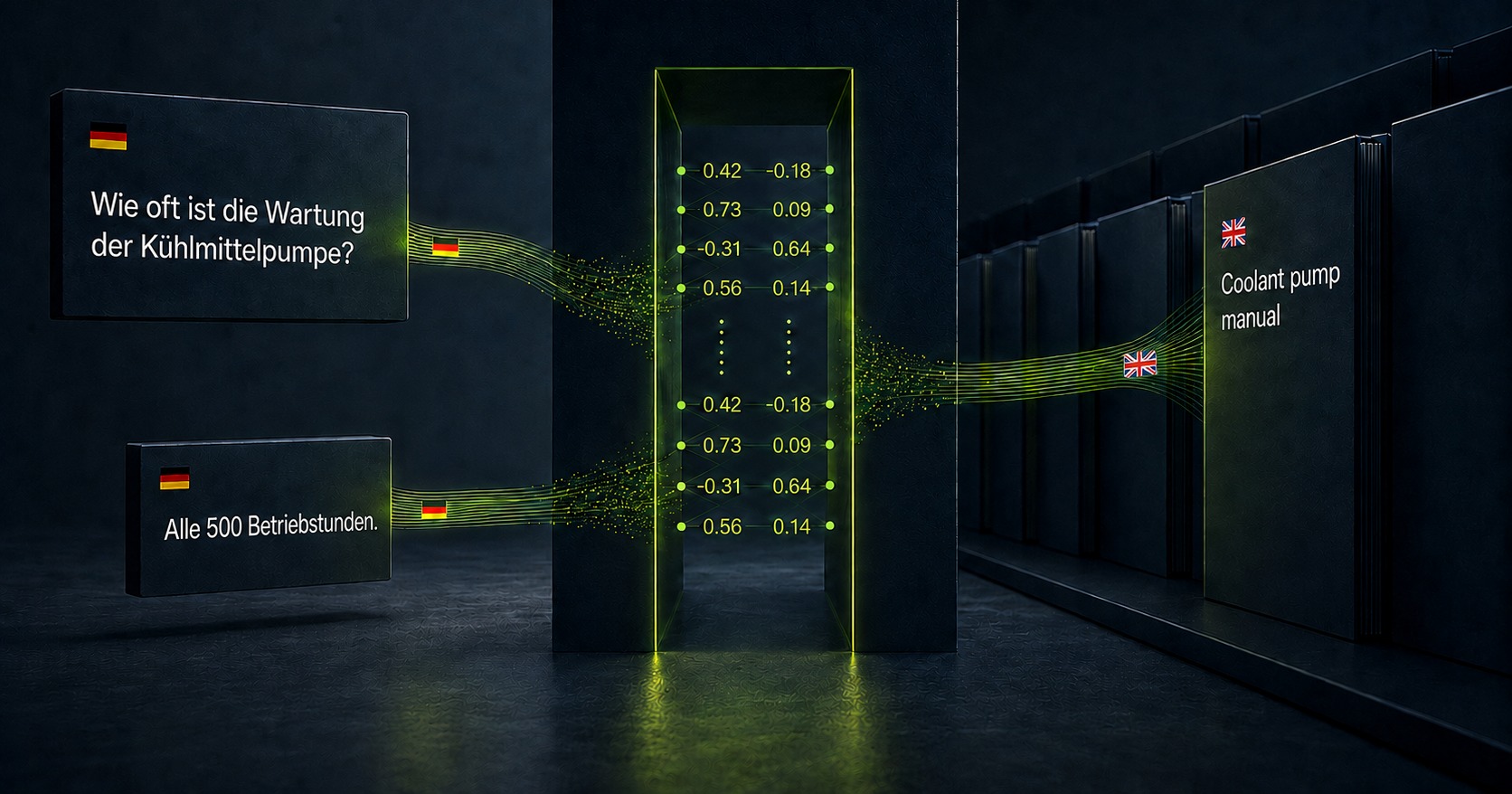
Before it sits a second model, which nobody sees. Its sole task is to determine which passages in the collection match the question at all. It compares meanings: each sentence is converted into a long sequence of numbers, and similar meanings end up close together. Put simply, it sorts sentences by meaning rather than words. The technical term is an embedding model.
We replaced the second model. The language model stayed as it was.
A multilingual embedding model places German and English sentences in the same space. A German question can then find an English paragraph because both mean the same thing, not because someone translated one into the other. No additional call, no additional waiting time, and above all no translation that could be wrong. The cost is a one-off re-indexing of the collection.
What the measurements showed
We measured the similarity between the German question “Wie oft muss die Kühlmittelpumpe gewartet werden?” (“How often does the coolant pump need servicing?”) and two English sentences from the same manual: one relevant, one irrelevant.
| Embedding model | Relevant sentence | Irrelevant sentence | Gap |
|---|---|---|---|
| Previous | 0.404 | 0.377 | 0.027 |
| New | 0.564 | 0.427 | 0.137 |
The absolute values are not what matters. The gap matters, because it determines whether a system can distinguish relevant from irrelevant results. The previous embedding model could barely do that across languages; a gap of 0.027 disappears into the noise. The new embedding model’s gap is 5.07 times larger.
In operation, it looks like this: a German question, nine results, and the English manual in first place. A lexical cross-check finds zero results, because not a single one of the German search terms appears in that text.
Why translate at all, then?
We do translate at one point, and the distinction is worth explaining.
Someone looking at an English source passage can have it translated into German with a click. On request, not automatically. And the original stays visible. The translation appears underneath, labelled as a “reading aid”, with a notice that the original remains authoritative.
That label is not a courtesy.
This is what happens when a language model encounters a technical term. The same English sentence, translated into German twice:
- First attempt: “The shaft fan must be inspected every 500 operating hours.”
- Second attempt: “The compressor must be inspected every 500 operating hours.”
These are English renderings of the two German outputs. The intended component was the impeller, called impeller in English and Laufrad in German. The language model guesses, and it guesses differently each time. What it got right is noteworthy: numbers, units and part numbers were correct in both cases. That was a firm requirement, because a technician acts on them.
The glossary in NXTGN AI CORE now constrains the translation. If a maintained technical term appears in the text, the language model receives the approved term in the target language as an instruction. The translation then says what it should say: “The impeller must be checked every 500 operating hours.” NXTGN AI CORE never suggests terms marked as prohibited in the terminology.
The “reading aid” label nevertheless remains. A glossary covers maintained terms, not every term.
The collection and the display
Behind this lies a distinction that guided us throughout the undertaking: the collection and the display are different things.
The collection is what the system treats as true and quotes from. Nothing generated afterwards belongs in it. The display is what a person is looking at at that moment. An aid may appear there, as long as it is recognisable as an aid and the original is shown alongside it.
Blurring that boundary is convenient, and initially nobody notices. Re-establishing it is almost impossible, because you would have to go back through a collection that has grown over time and distinguish original sources from generated material.
My conclusion
Much of the obvious approach made sense. Translation is regarded as a “solved problem”, the tools are available, and the effort is manageable. Nothing someone would set up a project for.
But every one of those translations would have entered the collection, and a collection is persistent. Its contents are found, quoted and passed on long after everyone has forgotten that they were once translated. An error in it does not age out; it multiplies.
That is why NXTGN AI CORE translates only where someone is looking and the original is visible alongside it. It sounds like a small detail, but it makes all the difference.
Usually, people notice that something in the collection was wrong only when nobody who knew better is still around.